
Trichomes
The cannabinoid factories of cannabis — and what their colour tells you about what's in your hand.
Everything that glints on a good bud of cannabis — that sticky, “frosty” surface your fingers come away wet from — those are trichomes. Microscopic outgrowths of the plant, and the whole story of cannabis as a psychoactive, aromatic and medicinal product begins here. No trichomes, no active compound.
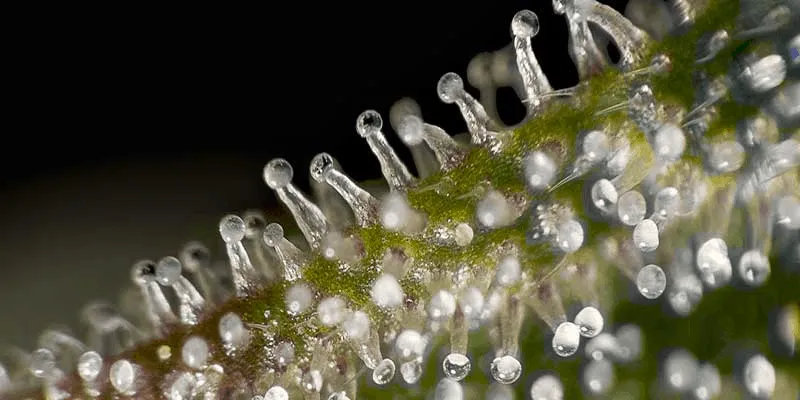
What they are
Under a microscope, trichomes look like fields of tiny stalks topped with a glassy bulb. The word is Greek — tríchōma, “growth of hair” — but in biological terms they aren’t really hairs. They’re closer to small glands.
The chemistry happens inside that bulb. THC, CBD, CBG, CBN — every cannabinoid we know — is produced here. Plus the terpenes that give cannabis its scent and flavour. Trichomes, in short, are the plant’s chemical factories.
Why the plant makes them
Several reasons at once:
- Sticky — catches or deters insects.
- Bitter — unappetising to hungry herbivores.
- UV-filtering — protects the flower’s DNA from strong sunlight.
- Strongly scented — attracts useful pollinators, repels others.
Evolutionarily useful for the plant. For humans — by happy accident — interesting in a very different way.
What you can read in them
Trichome colour tells you about ripeness. With good cannabis you’ll hear terms like:
- Clear / glassy — not yet ripe, low potency.
- Milky white — peak THC, powerful and clear-headed effect.
- Amber / brown — THC converting to CBN, a more sedating effect.
Good growers harvest at whichever point in this arc fits what they want to offer. You see that difference reflected in what’s on the counter here — and if you really want to know what you’re holding, just ask at the bar.